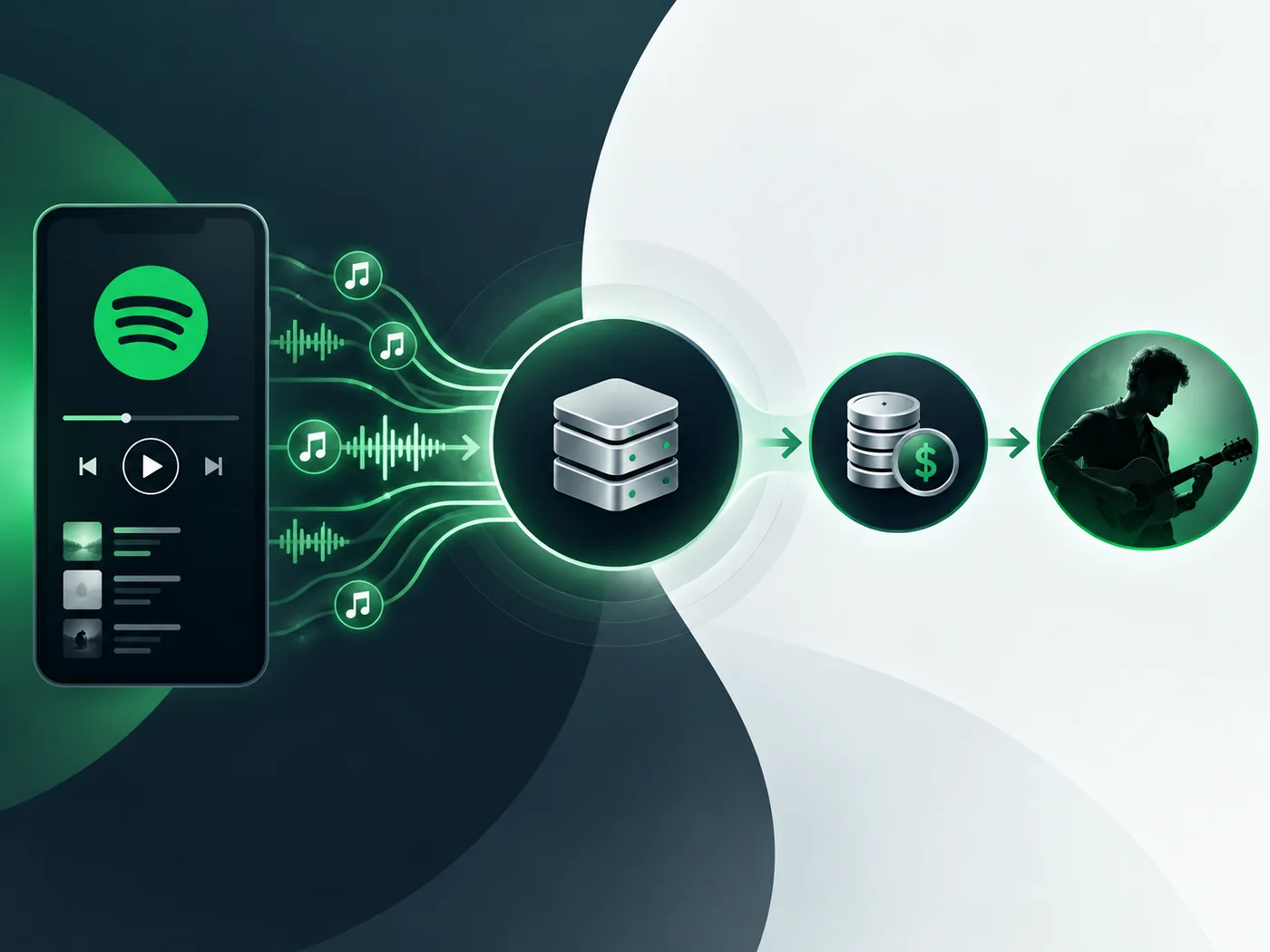
Spotify pay per stream: how much does one stream earn?
For a simple reference amount, one Spotify stream therefore represents about $0.003 on average, or three dollars per thousand streams.
This figure requires one important clarification: Spotify does not actually credit $0.003 every time someone plays a track. The platform pools revenue from Premium subscriptions and advertising, pays around two-thirds of it to music rights holders, then distributes that pool based on the share of streams. This system, known as streamshare, is what ultimately produces an average value per stream.
The figure of $3 per 1,000 streams is therefore mainly useful for projections. An artist preparing a release and aiming for 50,000 streams can use recording revenue of around $150 as a reference rather than assuming that a few tens of thousands of streams will immediately amount to a salary.
How much do artists make on Spotify?
Take an independent artist who fully owns their master. If their track reaches 100,000 streams and the reported revenue is close to the average of $3 per 1,000 streams, the recording will have generated around $300.
If they use a distributor that pays them 100% of net royalties, they keep that $300 before any of their own splits with other participants in the project.
With an agreement that includes a 15% commission, they would have about $255 left. If the master belongs to a label and their contract gives them, for example, 50% of the relevant revenue, their share may fall to around $150, or even less if other contractual provisions apply.
The question “how much does an artist make on Spotify?” therefore becomes much easier to understand: first look at how much the master generated, then look at who owns that master and how the revenue is split.
An artist who is also a songwriter or composer may also receive other rights-related revenue from the composition. Those amounts are not included in the simple calculation of master revenue.

Spotify revenue: master and publishing royalties
When a track is streamed, all of the revenue does not necessarily go to the same person. Take a song written by two songwriters, performed by a singer, with the master owned by a label. The singer may receive compensation specified in their contract with the label, the songwriters may receive royalties for the composition, and the label receives the revenue tied to the master before any subsequent redistribution.
For a fully independent artist, the situation can be much simpler: they write the track, compose it, perform it, and finance the recording themselves. They may therefore be entitled to both master revenue and rights related to the musical work.
This is an important distinction when looking at your Spotify revenue. The amounts reported by the distributor do not necessarily represent everything the song may generate. Our guide to music royalties explains these different types of revenue and how they flow, including your Spotify revenue.
Spotify artist royalties: why does the amount vary depending on streams?
Two tracks with 100,000 streams each may generate different amounts of revenue because they were not necessarily listened to by the same audience.
A catalog mainly listened to through Premium subscriptions in countries where subscriptions are relatively expensive does not have exactly the same economic profile as a catalog where a large share of streams comes from the ad-supported free service or from markets where revenue per user is lower.
The Spotify Discovery Mode program can also change the economics of certain streams. When an artist agrees to use Discovery Mode for certain tracks, Spotify applies a commission to the royalties generated in the relevant Discovery Mode contexts in exchange for potentially greater exposure.
There is therefore no single “right” magic figure that applies to every catalog. However, an average close to $3 per 1,000 streams remains accurate enough to estimate the scale of revenue before you have your own statements.
Spotify artist royalties and the role of the distributor
The distributor is involved at two very different stages: first, it allows the track to be placed on Spotify, then it collects the royalties corresponding to the recordings it distributed. This is why the price shown by a distributor is not enough to compare two offers.
Take an artist whose catalog eventually generates $10,000 in net royalties. With a 15% commission, the distributor keeps $1,500 and the artist receives $8,500. With a 10% commission, the deduction is still $1,000.
With a plan that allows the artist to keep 100% of net royalties, the full $10,000 remains available to the artist, who can then make their own splits with collaborators if necessary. For a new artist generating a few dozen dollars, this difference remains limited, but once a catalog starts reaching several hundred thousand or several million streams, the distributor’s compensation model becomes much more important than a few dollars of difference in the annual subscription price.
Dibsteur allows you to distribute your music on Spotify alongside the other partner platforms from the same account and keep 100% of net royalties.
How much does Spotify pay for 10,000 or 100,000 streams?
Using $3 per 1,000 streams as an average estimate, here is what the main streaming levels represent:
| Spotify streams | Estimated master revenue |
|---|
| 1,000 | about $3 |
| 10,000 | about $30 |
| 50,000 | about $150 |
| 100,000 | about $300 |
| 250,000 | about $750 |
| 500,000 | about $1,500 |
| 1,000,000 | about $3,000 |
| 5,000,000 | about $15,000 |
| 10,000,000 | about $30,000 |
This table mainly shows the economic reality of streaming. 100,000 streams already represent a solid audience for a track, but they still amount to only a few hundred dollars in recording revenue. To reach several thousand dollars, much larger volumes generally need to be accumulated.
This also explains why artists who make a living from streaming do not necessarily rely on a single track. A catalog of 20, 30, or 50 tracks that each continue to receive streams can generate revenue much more consistently than a single that experienced a very strong peak and then disappeared.
Artificial streams and Spotify royalties
Buying 100,000 streams while assuming you will automatically recover about $300 does not work.
Spotify analyzes listening behavior to identify artificial streaming. Streams considered fraudulent may be excluded from royalty calculations, and action may be taken when a track is associated with manipulation.
Most importantly, there is a fundamental difference between buying visibility and buying streams. An Instagram, TikTok, or YouTube ad can show a track to 100,000 people who then freely decide whether to listen to it. An offer directly promising “50,000 guaranteed Spotify streams” sells the result itself and should immediately be treated with caution.
A real audience can listen to future tracks, follow the artist, save a track, buy a concert ticket, or share the music. Fifty thousand artificial streams build none of that.
Spotify revenue: growing streams across your catalog
An artist who owns ten tracks generating 20,000 streams each per year reaches 200,000 total streams. If they then move to twenty tracks averaging 30,000 streams per track, their catalog already reaches 600,000 streams without any single track needing to go viral.
This is where the logic changes, because every new release can bring new listeners to older tracks. Someone discovers the latest single, visits the artist’s profile, listens to two previous tracks, then adds one to a personal playlist. The new track no longer generates only its own streams: it can revive the entire catalog.
Collaborations can also expose a track to the listeners of several artists. Playlists can extend its lifespan. An audience built on TikTok, Instagram, or YouTube can be brought back to Spotify with every new release.
For eligible tracks, Spotify Discovery Mode is another option for increasing their exposure in certain Spotify recommendation surfaces. It does not replace promoting a track, but it can contribute to discovery of the catalog.
The economic objective then becomes much more meaningful than “how much will my next single earn?”: how many tracks in my catalog continue to generate streams every month?
Track your Spotify revenue with Dibsteur
Before a first release, averages help put the numbers into perspective. Once the first revenue is generated, they become much less important: your own catalog data is the best reference.
An artist can see which tracks are actually generating streams, track their progress, and compare their performance over time. An older track can sometimes earn more than a new release simply because it remained in several playlists or continues to be discovered regularly.
Dibsteur centralizes statistics and revenue from partner platforms for distributed releases. The Sérénité and Label plans allow artists to keep 100% of net royalties, with no additional commission deducted from that revenue.
The features of the different plans are available on the Dibsteur music distribution plans page.