What is YouTube Content ID?
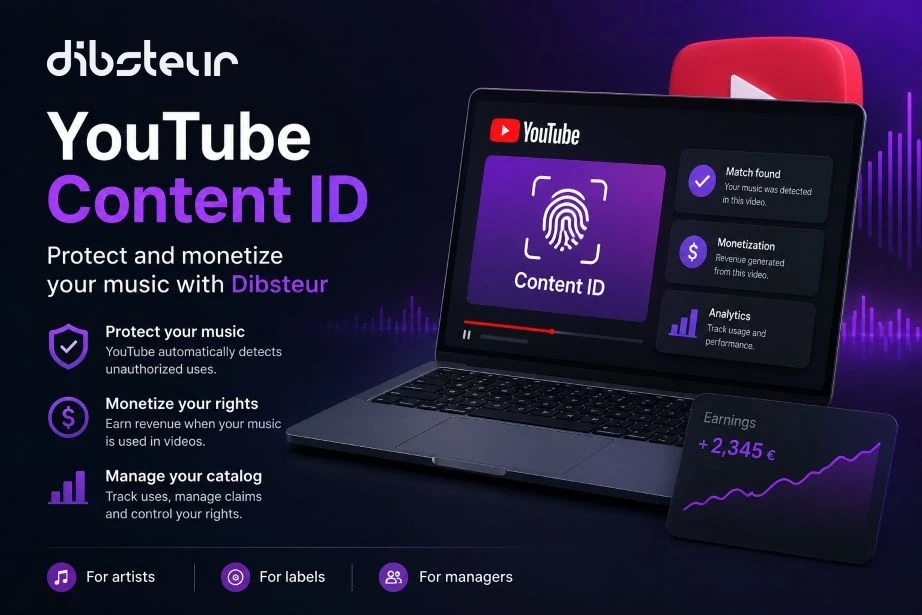
YouTube Content ID is a recognition system used by YouTube to automatically identify protected content in videos uploaded to the platform.
For music, an eligible recording can be used as a reference, and YouTube then compares new videos with that reference to detect matching uses.
Content ID should therefore not be thought of as a simple number added to a track. It is instead a system made up of several elements:
- an audio reference corresponding to the track;
- information relating to the rights;
- an automatic recognition system;
- rules used to determine what should happen when a match is found.
YouTube Content ID is not used to publish your music either, publishing and protection serve two different purposes. To protect your music, you need to consider the applicable rights alongside it.
YouTube Music allows you to distribute the track, while Content ID makes it possible to identify certain uses of that track in videos on YouTube.
With Dibsteur, these two dimensions can therefore be part of the same distribution strategy: making your music available on platforms while adding Content ID for eligible tracks.
Why use YouTube Content ID with Dibsteur?
For an independent artist, the difficulty is generally not understanding that they own rights to their music, the main problem is being able to manage them as uses multiply.
A track may be used in a few videos, then ten. Then one hundred. For a label or an artist with a large catalog, manually checking all these uses quickly becomes unrealistic.
That is precisely the value of Content ID: automating part of this search and management.
With Dibsteur, Content ID complements catalog distribution. The same artist can therefore use Dibsteur to distribute releases to partner platforms and benefit from YouTube Content ID for tracks that meet the necessary criteria.
The benefit is therefore not simply adding another feature. It is about covering two different uses of the same track, its official distribution on platforms, on one hand, certain uses of that recording in YouTube videos, on the other.
For an artist or label, this combination provides a more complete approach to distributing and exploiting their catalog.
What is YouTube Content ID used for by an artist?
Content ID becomes particularly useful when your music starts circulating outside your own accounts.
For example, a track may be used in:
- a regular YouTube video;
- a vlog;
- a gaming video;
- a presentation;
- a tutorial;
- an edit;
- content created by an influencer;
- a video uploaded by another artist or creator.
Without Content ID, finding all these uses can take a tremendous amount of time.
The system makes it possible to automate part of this process and can therefore help to:
- identify certain uses of your music;
- manage the associated rights;
- monetize certain uses when possible;
- limit certain uses according to the applicable rules;
- better manage a growing catalog.
For a Dibsteur artist, Content ID therefore complements distribution-related tools: it is not used to generate more streams on Spotify or Deezer, but to manage another part of how the track is used within the YouTube ecosystem.
Can you make money with YouTube Content ID?
Yes, Content ID can generate revenue when your music is used in certain YouTube videos. But this does not mean that every detection automatically generates a payment, let’s take another example:
A creator uploads a video containing your track. Content ID recognizes your recording and a monetization policy applies to that use.
The video can then continue to be shown with advertising and revenue related to the rights to the identified content can be allocated according to the applicable rules.
The benefit of Content ID is therefore to allow certain uses of your catalog to become identifiable and potentially monetizable.
This revenue is different from revenue generated directly by listening to your track on YouTube Music. In one case, a listener plays your track as they would on a streaming platform. In the other, your recording is used in a video uploaded by someone else.
For an artist using Dibsteur, Content ID can therefore complement revenue from traditional distribution by covering another type of use of their music.
Which tracks can use YouTube Content ID with Dibsteur?
Not all distributed tracks are automatically eligible for Content ID. Support depends in particular on the nature of the content and the rights held.
A completely original track for which the artist or label holds the necessary rights presents a much simpler situation than a track using several non-exclusive elements from third parties.
You therefore need to pay particular attention to:
- beats under a non-exclusive license;
- loops shared with other producers;
- samples;
- cover songs;
- excerpts from other recordings;
- content for which several people may claim the same rights.
Dibsteur includes YouTube Content ID in certain plans, but this does not change the eligibility rules imposed on the content. The artist or label must therefore hold the necessary rights for the track to be supported.
Before a track can be supported with Content ID through Dibsteur, two questions therefore need to be distinguished: Do I have the right to distribute this track? and Do I have the necessary rights for this recording to be used in Content ID? The answer may be different.
What is a Content ID claim?
A YouTube Content ID claim is a claim created when a match is found between a video and content referenced in Content ID. It indicates that protected content has been identified in the video.
A claim can then have different consequences depending on the policy applied: monetization, tracking, or restriction of the video. But it is important to distinguish a Content ID claim from a copyright strike, they are not the same thing.
A Content ID claim can be present on a video without the channel automatically receiving a copyright warning. This difference is essential to understanding the system: Content ID is not only a tool designed to penalize creators. It can allow a video to remain online while managing the rights associated with the music it uses.
What happens if the use of your music is authorized?
A Content ID detection does not automatically indicate that someone has used your track without permission. Imagine that you allow a videographer to use your music.
The Content ID system can still recognize the recording in their video. Recognition is automatic: it does not necessarily know about the specific agreement you have made with that person.
The same situation can occur when a creator has a license allowing them to use the track. This is why a Content ID claim must be disputable.
Can you dispute a Content ID claim?
Yes, a creator who believes that a claim is not justified can use YouTube’s dispute process.
This can happen in particular when they:
- have a license;
- received permission;
- hold certain rights themselves;
- believe the wrong music was recognized;
- believe the claim does not correspond to their use.
Managing Content ID therefore does not simply mean creating as many claims as possible. References must be accurate and claims must correspond to rights that are actually held.
For Dibsteur as well as for the artist or label, the quality of rights information is therefore essential to using the service correctly.
Is YouTube Content ID free?
A YouTube channel does not automatically provide access to Content ID. Direct access to the system is reserved for certain rights holders and partners that meet YouTube’s criteria.
For an independent artist, using a distributor or partner that offers Content ID is therefore generally a much more accessible solution.
However, care should be taken when searching for “free YouTube Content ID”.
Depending on the provider, the model may differ:
- service included in a subscription;
- paid option;
- commission on certain revenue;
- specific conditions depending on the tracks.
At Dibsteur, YouTube Content ID is included in the Sérénité and Label plans for content that can be supported.
You should therefore consider the cost of the distribution plan as a whole rather than treating Content ID as an isolated service.
YouTube Music vs. YouTube Content ID: what’s the difference?
The confusion is common, but the difference is important.
YouTube Music is used to distribute your track
YouTube Music works like a streaming platform.
With a music distributor such as Dibsteur, an artist can make their single, EP, or album available on YouTube Music just as they do to distribute their music on Spotify, Apple Music, or Deezer.
YouTube Content ID is used to manage other uses
Content ID comes into play when referenced music appears in a YouTube video. It is therefore not intended to replace YouTube Music, the two work together.
An artist can officially distribute their track on YouTube Music and use Content ID to manage certain uses of the same recording in other videos.
It is this combination that makes the service valuable as part of a music distribution offering such as Dibsteur.
Using YouTube Content ID with Dibsteur
Dibsteur allows artists, labels, and managers to manage their music distribution from the same environment.
The Sérénité and Label plans include YouTube Content ID among their services for eligible tracks.
The goal is not to completely separate distribution from managing rights related to YouTube uses.
You can therefore prepare your catalog for distribution to partner platforms while Content ID complements that distribution for tracks that can be supported.
In practical terms, the process is as follows:
- you distribute your music;
- eligible tracks can benefit from the Content ID service;
- YouTube can then recognize certain uses of these recordings in videos on the platform;
- the corresponding claims make it possible to apply the rules established for those uses.
For an independent artist, this notably avoids having to seek direct access to YouTube’s Content ID system themselves.
For a label or manager with a larger catalog, the benefit is even greater: Content ID makes it possible to extend rights management to uses that would be practically impossible to find manually, video by video.
Dibsteur does not, however, replace the need to hold the necessary rights. Tracks must meet the criteria that allow them to be supported by Content ID.
Compare Dibsteur Music Distribution Plans