Music copyright: definition and protection of the work
When an artist writes lyrics, composes a melody, or creates an original musical work, authors' rights do not depend on the track being published on Spotify or registered with a distributor. In France, protection arises when the work is created, without any particular formality being required for authors' rights to exist.
This does not mean that keeping evidence is unnecessary. In the event of a dispute, it may become necessary to demonstrate that the work existed on a certain date and establish who created it. Keeping working files, different versions of the project, exchanges between collaborators, or using a method that makes it possible to date the creation can therefore be genuinely useful.
Authors' rights in music include, in particular, economic rights, which make it possible to authorize certain uses of the work and receive the resulting revenue, as well as moral rights, which protect the connection between the author and their creation.
Musical work and master recording: two elements to distinguish
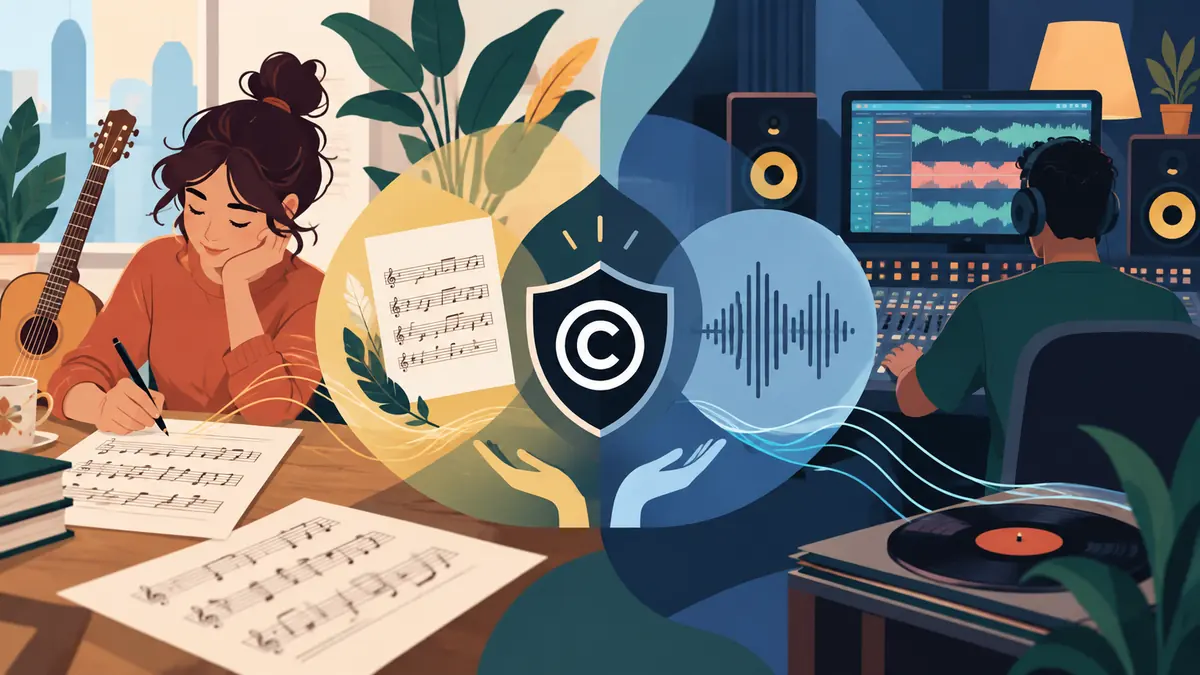
The same song can exist as several recordings. The composition remains the same, but each recorded version constitutes a different master. Before distribution, that recording can then go through a stage of online mastering to prepare its final version.
Take a song written by a songwriter-composer: they may record a first studio version, then an acoustic version a few years later, and another artist may also cover the same work. The lyrics and composition remain associated with the musical work, while each recording has its own separate existence.
This distinction explains why several types of revenue can coexist around the same track. The author of a song does not necessarily own the master, and the owner of the master is not necessarily the only author or composer.
It also explains the difference between certain identifiers used in the music industry. The ISRC code identifies a specific recording, not the musical work as a whole.
SACEM: definition and role in music authors' rights
SACEM is a collective management organization that works in particular for authors, composers, and publishers who entrust it with the management of certain rights.
Its role is therefore not to distribute a track directly to Spotify, Apple Music, or Deezer. It handles the part relating to the work and the rights it manages for its members, collecting and then distributing the corresponding amounts according to uses declared or identified within the scope of its activities.
It is important not to confuse two things: being protected by authors' rights and being a member of SACEM. A work does not become protected solely because it is registered with SACEM. Collective management is used to administer and collect certain rights; it does not, by itself, create the legal existence of the work.
For an artist who writes and composes their own tracks, SACEM can therefore complement the role of the distributor, but the two do not operate on the same part of the project.
Duration of music copyright
The duration of music copyright does not end when the track disappears from the charts or the artist stops promoting it.
In France, economic rights are, as a general rule, protected throughout the author's lifetime and then for 70 years after their death, subject to certain specific rules that may apply depending on the works and circumstances.
At the end of this period, the work may enter the public domain for the economic rights concerned. This does not necessarily mean that all existing recordings become free to use: an older work and its sound recording are two different things.
A classical composition may, for example, be in the public domain while a recent recording of that composition remains protected by the rights applicable to that recording.
Moral rights, meanwhile, are governed by a different regime and benefit from particularly strong protection in France.
Neighboring rights in music: performers and producers
Neighboring rights in music complement authors' rights. They concern, in particular, people who participate in the exploitation of music without necessarily being the authors of the work itself.
A singer may perform a song written by someone else. A musician may participate in the recording without having composed the track. The producer of the sound recording may, for their part, have financed or taken responsibility for the recording.
These situations create rights that are distinct from those associated with the composition. For an independent artist who writes, performs, produces, and finances their own track, several of these roles may be combined in one person. In other projects, they are divided among different participants, making it particularly important to determine from the outset who owns what.
Music copyright and authors' rights in France
The term music copyright is very commonly used online, particularly because platforms and many international services use English-language terminology.
In France, the legal framework is based primarily on authors' rights and neighboring rights. The concepts of copyright and authors' rights are therefore not perfectly interchangeable, even though the word copyright is commonly used to refer to the protection of a creation or the authorization required to use it.
Adding the © symbol to a track, cover art, or website does not by itself create protection. Similarly, not displaying this symbol does not mean that a work may be freely reused.
For an artist distributing music internationally, however, it is normal to encounter both types of terminology depending on the platforms and countries concerned.
Protecting your music before distributing it
Before a track is released, the first precaution is to be able to clearly demonstrate the origin of the project and the people who participated in it.
To protect your music, it is useful to keep creation files, successive exports, production sessions, exchanges with collaborators, and agreements made around the track. When a work is written or composed by several people, it is also better to define the split between the different authors and composers before the track begins generating revenue.
A deposit or the use of a system that provides dated proof can strengthen this traceability. The objective is not to replace authors' rights, which exist independently of this process, but to make it easier to provide evidence in the event of a later dispute.
Distribution then takes place once the track is ready to be exploited. At this stage, the metadata, credits, final master, and identifiers must correspond to the project that is actually authorized for distribution.
Beats, samples, and collaborations: checking rights before release
An artist may be the author of their lyrics while not having all the necessary rights to the other elements of the track.
The use of a beat purchased online depends, for example, on the license granted by its producer. Some licenses are non-exclusive and may be used by several artists; others include specific restrictions regarding distribution, monetization, or certain uses.
The presence of a sample also requires particular attention. The fact that an excerpt is short, modified, or difficult to recognize does not automatically mean that it can be used without authorization.
When a track brings together several artists, producers, or composers, defining the contributions and the split before release also prevents the issue from being discovered after the first music royalties have been generated.
Authors' rights, royalties, and streaming revenue
A stream can contribute to several revenue streams without the entire amount automatically going to the same person.
The part associated with exploitation of the master and the part associated with the work must be distinguished. For an independent artist who owns their recording, the distributor plays a role in particular in passing along the revenue corresponding to distributed releases, while authors' rights follow the channels applicable to the composition and the management of those rights.
This is why the amount displayed by a distributor does not necessarily represent all the revenue that may exist around a song.
We explain these different revenue streams in more detail in our guide to music royalties. This distinction becomes particularly important for artists who perform several roles at once, because a singer-songwriter who also owns their master may be concerned by several categories of revenue generated by the same track.
Authors' rights and music distribution: the role of the distributor
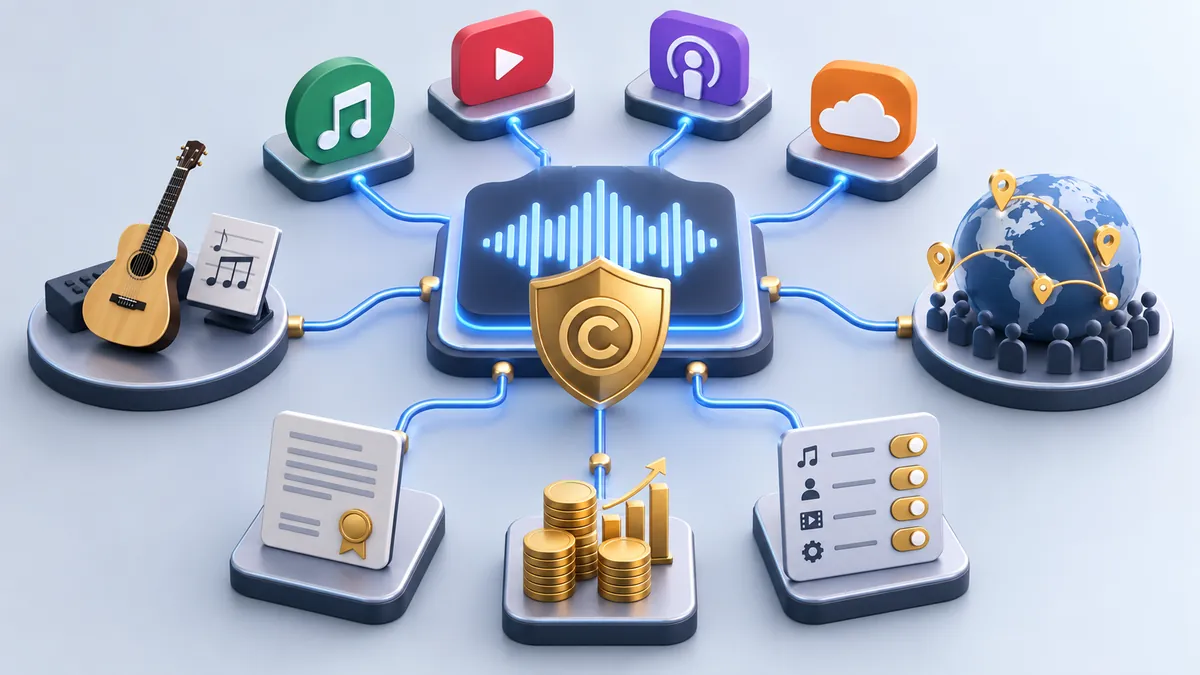
A music distributor is not intended to replace SACEM or the organizations that manage authors' rights.
Its main role is to prepare and deliver recordings to the selected platforms, manage the information associated with releases, and then pass along the data and revenue corresponding to distribution according to the plan used.
When Dibsteur distributes a track to Spotify, Apple Music, Deezer, or the other available services, this therefore primarily concerns the exploitation of the distributed recording. The rights associated with the composition continue to exist independently of this distribution.
This separation explains why an artist needs to understand both the rights associated with their work and those concerning their master. Managing one properly does not automatically mean that the other is taken care of.
The Dibsteur music distribution plans make it possible to manage the publication and tracking of releases, while procedures relating to other rights remain separate when they are necessary. To protect your music on YouTube, it is also important to understand the rights attached to each item of content.
YouTube Content ID and protection of recordings
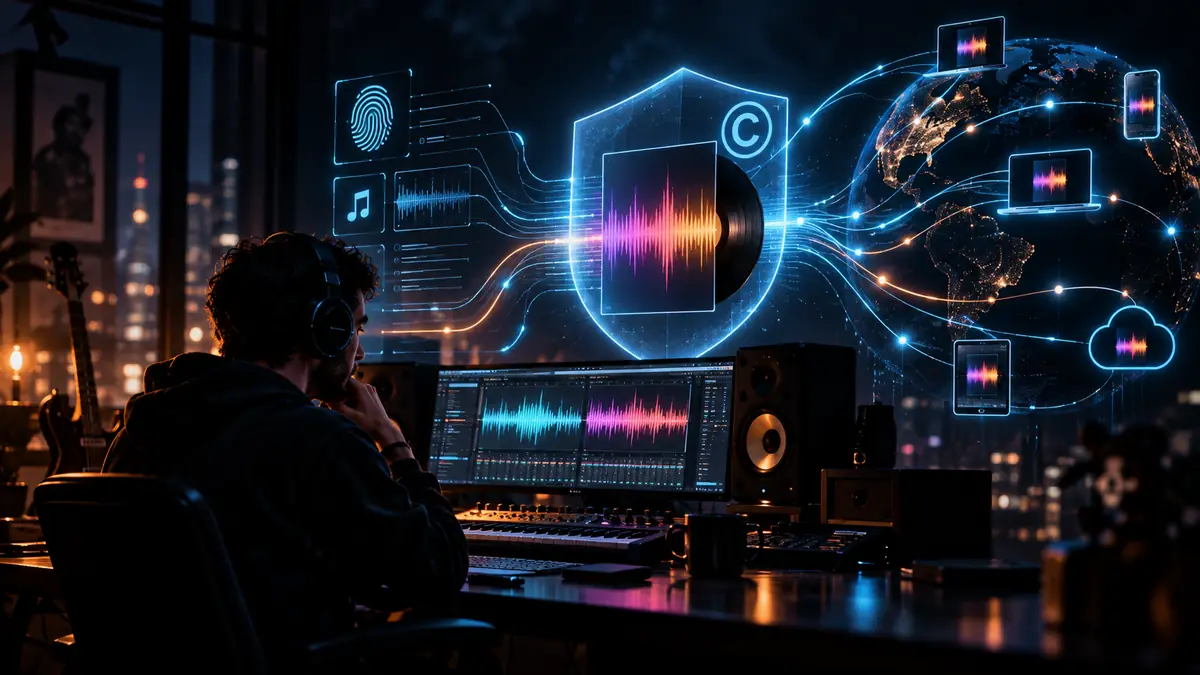
When music is used in a YouTube video, the question is no longer simply whether the track exists on a streaming platform; it must also be possible to identify the recording when it appears in other content.
YouTube Content ID is based on a recognition system that compares uploaded content with references registered in the system. Depending on the rights held and the applicable policies, certain uses can then be identified and may be subject to an action provided for by the relevant rights holder.
This system does not replace authors' rights and does not mean that an artist can claim any track they distribute. They must hold the necessary rights to the content used as a reference, which becomes particularly important when a track relies on certain beats, samples, or elements under a non-exclusive license.
Content ID is therefore a tool for managing and identifying certain uses of a recording, not a method for creating rights that the artist does not already own.
ISRC code, musical work, and rights to the recording
The ISRC code is sometimes confused with a legal protection system, but its role is different.
This identifier makes it possible to distinguish a specific recording within the music ecosystem. It accompanies the master when it is exploited and facilitates its identification in data exchanges. By itself, it does not prove that the person who holds it is the author of the composition or owns all the rights associated with the work.
A song can therefore retain the same musical work while giving rise to several recordings, each with a different ISRC.
This difference between the work and the recording is explained in detail in our guide to the ISRC code.