Distribute your music on streaming platforms
Spotify, Apple Music, and Deezer do not work like platforms where an independent artist can simply upload an audio file directly to launch a commercial release.
One of the roles of a music distributor is to deliver the project and its information to the various services concerned. Instead of preparing a release separately for each platform, the artist creates the project and then chooses the destinations where they want to make it available.
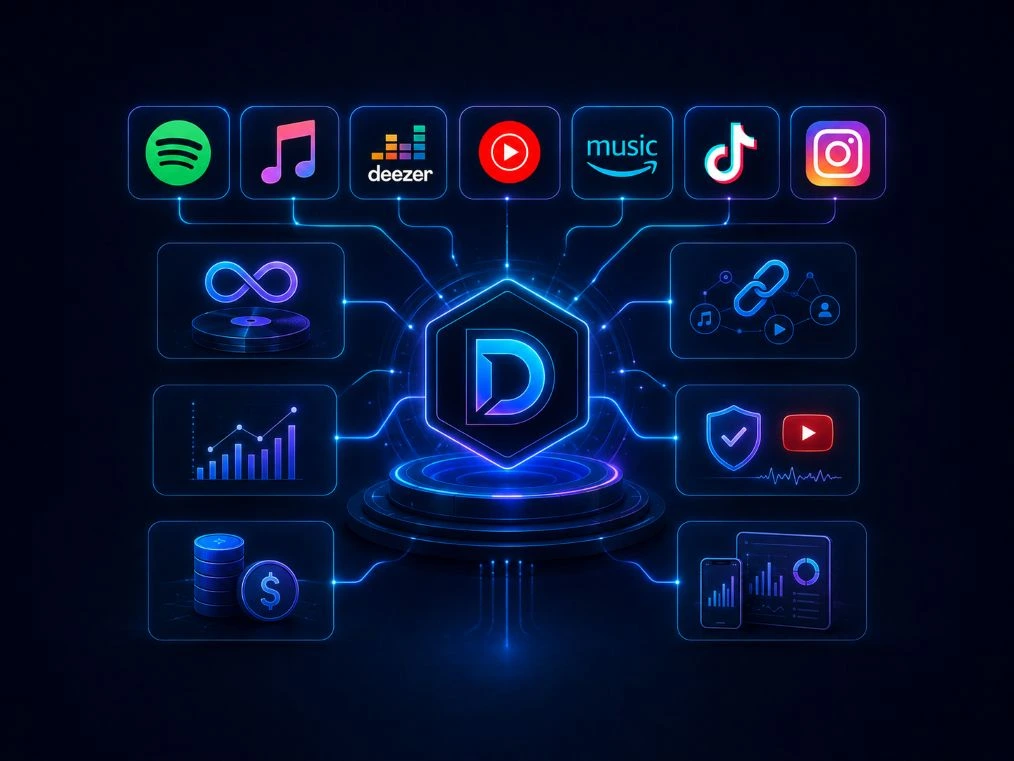
Dibsteur currently distributes music to more than 35 platforms and digital services. This includes the major streaming platforms, but also other services and networks where music can be listened to or used. The exact list of available platforms is therefore much broader than Spotify, Deezer, or Apple Music. To choose the right format, see our guide to EPs, singles, and albums.
Find the complete list of available services on our page dedicated to music distribution platforms.
A music distributor also designed for independent artists
Digital music distribution has profoundly changed the way an artist can publish music.
It is no longer necessary to be signed to a traditional label to make a track available on the major streaming platforms. An independent artist can use a music distributor to access the same digital services and organize their own release schedule.
This is particularly useful when releases become regular. An artist who releases several singles during the year, followed by an EP or an album, does not have the same needs as someone who occasionally publishes a track.
Dibsteur notably offers unlimited releases in its current plans, allowing artists to publish regularly without worrying about the cost of each new release and to focus on developing their music project.
Spotify, Apple Music, Deezer, Amazon Music: where can you distribute your music?
Not all platforms should be considered a single channel. Spotify may be central to one artist’s strategy, while another listener may primarily listen to their music on Apple Music, Deezer, or Amazon Music. Some platforms are also stronger in certain countries than in others.
Distributing widely therefore primarily makes it possible to avoid forcing your audience to use a particular service.
Distribute your music on Spotify
Dibsteur makes it possible to distribute singles, EPs, and albums on Spotify so that releases are available on one of the leading music streaming platforms. However, publishing requires properly preparing the project, including the audio files, cover artwork, metadata, and artist information. To learn more, we explain the different steps and points to check in our guide on how to upload your music to Spotify with Dibsteur.
Distribute your music on Apple Music
Apple Music stands out in particular for its integration with the Apple ecosystem and for an audience that is highly present on iPhone, iPad, Mac, and CarPlay. For an artist, distributing music there also makes it possible to be present in an environment where audio quality, albums, credits, and catalog presentation continue to play an important role.
Distribute your music on Deezer
Deezer remains particularly relevant in France and several French-speaking markets. The platform also highlights editorial tools, playlists, and features designed for music discovery, making it an interesting channel for complementing a distribution strategy aimed at French audiences.
Distribute your music on other platforms
Amazon Music, YouTube Music, TIDAL, Pandora, Anghami, JioSaavn, and Tencent Music make it possible to reach very different types of usage and markets. Some are very strong in a specific country or region, while others rely on a particular ecosystem or specific ways of using music.
Dibsteur currently makes it possible to distribute music to more than 35 platforms and digital services to diversify and be present everywhere.
How does Dibsteur manage your music royalties?
Music royalties are the revenue generated by the use of a track on the various platforms and services where it is distributed. The amount may vary depending on the platform, type of stream, country, or compensation rules applied by each service.
With Dibsteur, revenue related to distributed projects is reported in the same environment used to manage releases. Artists can therefore track their royalties without having to manually centralize information from each platform.
With the Sérénité plan, Dibsteur allows artists to keep 100% of the net royalties generated through distribution.
However, royalties from the distribution of a recording must be distinguished from other revenue that may exist around a musical work. Copyright, music publishing, or the distribution of revenue among several rights holders may follow different mechanisms.
The main benefit of Dibsteur is therefore to bring music distribution, release tracking, and related revenue together in a single space.
Track your music statistics after distribution
Once a track is available on the platforms, the artist must be able to understand what is actually happening after it goes live. The first few hours do not always provide an accurate picture of performance. Some releases quickly generate streams, while others grow over several days or several weeks.
Dibsteur provides detailed daily statistics that make it possible to track the progress of distributed tracks and more easily compare the performance of several releases. This becomes particularly useful as the catalog begins to grow, with several singles, EPs, or albums available at the same time.
This tracking is not only used to look at the number of streams. It also makes it possible to maintain an overall view of the catalog, compare several releases, and better understand the development of each project after publication.
YouTube Content ID to protect and monetize your music
YouTube does not work exactly like Spotify, Apple Music, or Deezer. A track can be officially published by the artist, but it can also appear in a video uploaded by another user.
This is where YouTube Content ID comes in. The system compares certain content published on YouTube with eligible music references. When a match is detected, a claim can be created and different rules can then be applied depending on the rights associated with the track. Depending on the associated rights and the policy applied, a detected use may notably be monetized, tracked, or subject to other measures.
Content ID is not simply a number added to a piece of music, nor does it guarantee that a detection will systematically generate revenue. Its role is primarily to make it easier to identify and manage certain uses on YouTube.
Dibsteur offers YouTube Content ID with certain plans for tracks that meet the necessary requirements. How claims work, eligibility rules, and the difference between a claim and a copyright strike are detailed on our page dedicated to YouTube Content ID with Dibsteur.
Music SmartLink: bring your platforms together in a single link
Distributing a track on several platforms then raises a very simple question: which link should you share?
One listener may listen to your music on Spotify, another on Deezer, and a third on Apple Music. Publishing several links separately quickly makes communication less clear, particularly on social media or when promoting a new release.
A SmartLink makes it possible to bring several destinations together on a single page. The artist shares one address, and each listener then chooses the service they use.
Dibsteur plans currently include customizable SmartLinks, making it possible to keep communication simpler around a single, EP, or album that is already available on several platforms.
Music distribution for labels and managers
Needs change when you are no longer managing a single artist but several catalogs.
A label or manager must notably be able to find the different releases, track several projects, and avoid unnecessarily multiplying the accounts or tools used for each artist.
Dibsteur’s Label plan currently makes it possible to manage up to 10 artists included in the plan. Distribution and tracking can therefore be grouped together in the same environment, while maintaining an organization suited to several catalogs. See the details of this plan on our page dedicated to music distribution for labels.
This use is different from that of an independent artist who manages only their own releases, which also explains the existence of a plan specifically intended for labels and managers.
How much does a music distributor cost?
Music distribution services do not all use the same business model. Some charge for each release separately, others take a commission on the revenue generated, while some operate with an annual subscription.
Comparing only the displayed price is therefore not enough. An artist must also look at what is included: number of releases, number of artists, platforms served, any commissions, statistics, promotional tools, or additional services.
Dibsteur notably offers a Sérénité plan intended for artists and a Label plan for organizations that manage several projects. The Dibsteur music distribution plans notably include unlimited distribution, detailed daily statistics, and customizable SmartLinks. With the Sérénité plan, the artist also keeps 100% of their net royalties.
Why choose Dibsteur as your digital music distributor?
Choosing a digital music distributor does not depend on a single feature. An artist who releases several tracks during the year will not necessarily be looking for the same thing as a label that needs to track ten catalogs, and a project that simply wants to be present on Spotify does not have the same needs as an artist who wants broad distribution and to track revenue over time.
Dibsteur currently brings together several functions related to music distribution in a single solution:
- more than 35,000 artists use the platform;
- distribution to more than 35 digital services;
- unlimited releases in the applicable plans;
- 100% of net royalties with the Sérénité plan;
- detailed daily statistics;
- customizable SmartLinks;
- YouTube Content ID for eligible content;
- mobile app making it possible, in particular, to manage distributions and track revenue.
Dibsteur is also a French music distributor, intended for independent artists, labels, and managers who want to manage their distribution from a solution based in France.
Distribute your next project with Dibsteur
Online music distribution begins with making a track available on platforms, but it then continues with tracking releases, statistics, revenue, and the various tools associated with the project.
Dibsteur brings these functions together in a single environment, whether you are preparing your first single, several releases throughout the year, or already managing different artists. Distribute your music online with Dibsteur in several steps:
Create your Dibsteur account
The artist begins by creating their account and choosing the plan suited to their project, whether they are an independent artist, a manager, or a label managing several catalogs.
Prepare your release
Next, the elements required for distribution must be provided: audio file, cover artwork, track title, artist name, project-related information, and release date.
Choose the platforms
Once the project is ready, the artist selects the platforms where they want to make their music available from among the services offered by Dibsteur.
Send the project for distribution
The track can then be delivered to the selected platforms as part of the distribution process. The goal is to centralize this step without having to prepare a release separately for each service.
Track your music after release
After it goes live, Dibsteur makes it possible to track detailed daily statistics and the revenue associated with the various distributed projects.
Use the additional tools
Depending on the plan and content eligibility, the artist can also use SmartLinks to bring their platforms together and YouTube Content ID to manage certain uses of their music on YouTube.