A music distributor for record labels
The work of a record label is not limited to sending a track to Spotify or Deezer. Multiple artists may be preparing releases simultaneously, each with their own catalog, release dates, and performance.
A music distributor for a label therefore needs to make it possible to stay perfectly organized as the number of projects increases.
With Dibsteur, the label can bring together the artists included in its plan and manage their music distribution from the same solution. Releases are unlimited under the Label plan, making it possible to release multiple singles, EPs, or albums throughout the year without additional charges for each new distribution.
This organization becomes particularly useful for independent labels that start with a few artists and then gradually expand their catalog.
Manage multiple artists and their catalogs from the same account
A music catalog can quickly become difficult to track when each artist has multiple releases. A label needs to be able to distinguish between projects, find each artist’s information, and track the progress of different releases without having to rebuild its organization for every release.
The Dibsteur Label plan currently includes 10 artists, so each project can be integrated into a common organization while retaining the information specific to the artist concerned.
This allows the label to maintain a broader view of its activity: artists in preparation, projects already distributed, new singles, albums, and revenue generated by the different catalogs.
Unlimited distribution for the label’s artists
Release frequency can vary significantly from one artist to another. Some projects release a few tracks during the year, while others build their strategy around regular singles before releasing an EP or album. For a label, charging separately for each distribution can quickly complicate the budget when multiple artists are releasing music at the same time.
Dibsteur’s Label plan includes unlimited distribution of projects from artists managed within the account. The label can therefore organize its release schedule based on its music strategy rather than on the number of tracks it has left to distribute.
Distribute the label’s artists on streaming platforms
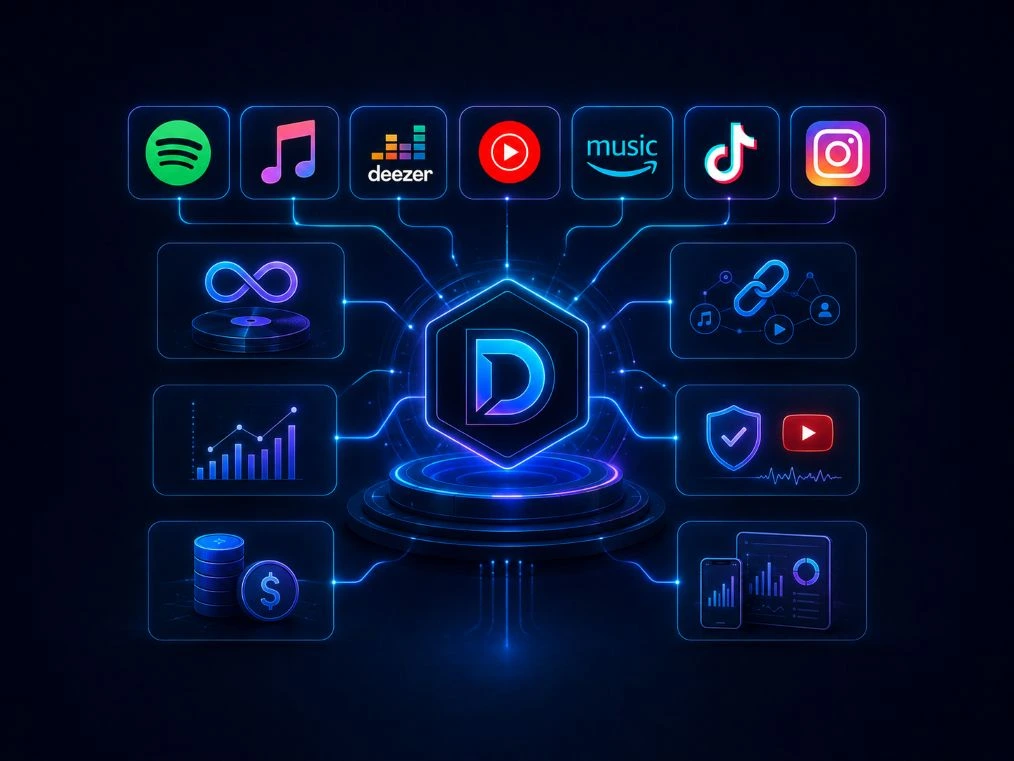
Catalogs can be distributed to the different platforms supported by Dibsteur: Spotify, Apple Music, Deezer, Amazon Music, YouTube, and many other digital services.
This centralized distribution avoids having to prepare a different process for each platform and each artist.
Dibsteur currently distributes to more than 35 platforms and digital services. The list and specific features of these different destinations are grouped together on our page dedicated to music distribution platforms.
For platforms that require more explanation, specific resources also provide more detail on how distribution works, particularly for getting your music on Spotify or on Deezer.
Split royalties between the label and artists
Financial management quickly becomes a central issue when a single account brings together multiple artists. The Dibsteur Label plan includes royalty split features, notably between the label and the artists. This makes it possible to integrate the question of revenue sharing directly into the organization of the catalog, rather than considering each release only as an isolated project.
The exact percentages and terms must naturally correspond to the agreements concluded between the label and the artists concerned. Dibsteur also allows you to keep 100% of net royalties under the current Label plan.
This feature obviously does not replace the contracts or legal agreements that exist between the different parties: the tool is intended to facilitate the management of revenue generated through distribution.
Track revenue from multiple artists
When a label begins managing multiple catalogs, looking only at overall performance is no longer enough.
It becomes necessary to be able to identify the revenue generated by different projects, compare releases, and maintain a sufficiently clear history to track the label’s activity.
Dibsteur provides detailed financial reports as well as daily statistics for distributed projects. The label can therefore maintain a more precise view of its catalogs and how they evolve.
This centralization is particularly useful when the same artist has multiple releases or when different artists are active at the same time.
Music statistics to track each catalog
Data also makes it possible to see what is happening before focusing solely on revenue.
One release may progress quickly while another finds its audience several weeks after its release. With multiple artists, these differences become difficult to track without a centralized view.
The daily statistics provided by Dibsteur allow the label to monitor the performance of distributed projects and more easily identify significant changes across the different catalogs.
Tracking can then be supplemented by platform-specific tools, such as Spotify for Artists or Deezer for Creators, when an artist wants to analyze their presence on a particular service in greater detail.
Migrate an already distributed catalog
Creating a Label account does not necessarily mean starting from scratch. A label may already have multiple artists and tracks released through another distributor. In this case, catalog migration needs to make it possible to maintain a consistent organization while gradually transferring distribution.
The Dibsteur Label plan currently includes migration assistance as well as the transfer of previously released projects. This can be particularly important for a label that wants to change distributors without abandoning releases that are already available on platforms.
YouTube Content ID for eligible catalogs
A label may also need to manage the use of its tracks outside their standard distribution on streaming platforms.
YouTube Content ID makes it possible to identify certain uses of eligible tracks in videos published on YouTube. Depending on the associated rights and the rules applied, a match may notably result in a claim or specific management of the use.
The Dibsteur Label plan includes YouTube Content ID for content that meets the necessary requirements.
The precise way the system works, eligibility, and the differences from a copyright strike are explained on our page dedicated to YouTube Content ID with Dibsteur.
SmartLinks for artist releases
Each artist has their own releases and therefore their own communication needs. SmartLinks make it possible to bring multiple platforms together under a single link so that listeners can choose their listening service. For a label that manages many singles or albums, this makes it easier to create a single entry point for each new release.
Customizable SmartLinks are among the features currently included in the Label plan.
ISRC and UPC codes to organize releases
Managing a catalog also involves identifying the different recordings and projects.
The Label plan notably makes it possible to use customizable ISRC and UPC codes, which can be useful for a label that already has its own organization or references.
This option becomes increasingly important as the catalog grows and the label wants to maintain consistent organization across its different releases.
A plan designed for independent record labels
Not all labels have the size or needs of a major label.
An independent record label may manage only a few artists while already needing a more structured solution than an account intended for a single project. The Dibsteur Label plan currently includes, among other things:
- up to 10 included artists;
- unlimited distribution;
- more than 35 platforms and digital services;
- 100% of net royalties;
- royalty splits and label/artist splits;
- detailed daily statistics;
- financial reports;
- customizable SmartLinks;
- YouTube Content ID for eligible content;
- Spotify Discovery Mode;
- migration assistance;
- customizable ISRC and UPC codes.
The benefit is therefore less about multiplying features than about being able to use them in a common environment for multiple artists.
A custom plan for larger labels and projects
The Label plan meets the needs of organizations that want to manage multiple artists from the same environment. For larger labels, more complex catalogs, or projects that require specific support, Dibsteur also offers a Custom plan.
This option may be suitable for labels, managers, or artists who want to go beyond standard use of the platform and receive more personalized support. Dibsteur notably provides a dedicated project manager, end-to-end managed distribution, as well as terms adapted to the project, with the possibility of an advance or a specific rate depending on the situation.
It therefore makes it possible to keep Dibsteur as a distribution partner even when the number of artists, release volume, or catalog needs exceed the standard scope of the Label plan.
What is the price of the Dibsteur Label plan?
The Label plan is currently offered at 139.99 € per year, with 10 artists included and no annual commitment beyond the subscription period.
When comparing a music distribution solution for labels, however, the price needs to be considered alongside what is actually included: number of artists, release limits, royalty commissions, reporting tools, splits, and additional services.