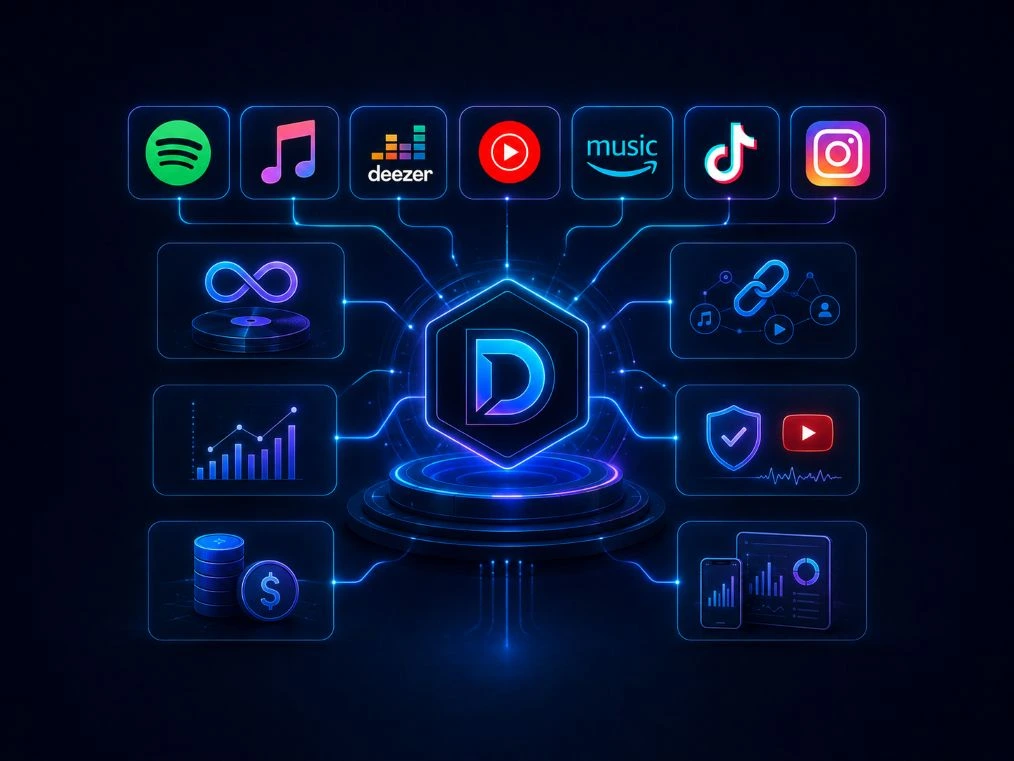
The main music streaming platforms
Spotify
Spotify is currently one of the largest music streaming services in the world. In the second quarter of 2026, the platform reported 777 million monthly active users and 300 million Premium subscribers.
For an artist, Spotify is not only a place to host a catalog: the platform also relies heavily on playlists, personalized recommendations, and discovery tools. Dibsteur makes it possible to distribute singles, EPs, and albums there.
For the steps specific to Spotify, we already have a complete guide explaining how to put your music on Spotify.
Apple Music
Apple Music is part of the Apple ecosystem and integrates with iPhone, iPad, Mac, Apple Watch, and CarPlay, among others. The platform also stands out for the importance it places on audio quality, with Lossless and Spatial Audio with Dolby Atmos.
It is therefore an important destination for artists who want their catalog to be available within the Apple environment, with a complete presentation of albums, credits, and releases.
Dibsteur makes it possible to include Apple Music among the platforms selected for the distribution of a project.
Deezer
Deezer remains particularly important in France. In the first half of 2026, the service reported 3.9 million direct subscribers in France, up 8.4% year over year.
The platform is based on on-demand listening, recommendations, editorial playlists, and music discovery tools. For a French or French-speaking artist, Deezer therefore remains a platform to consider alongside the major international services.
Dibsteur makes it possible to distribute singles, EPs, and albums there.
For the steps specific to Deezer, we already have a complete guide explaining how to upload your music to Deezer.
Amazon Music
Amazon Music is part of the Amazon ecosystem and benefits in particular from its integration with devices that use Alexa.
Its appeal therefore also comes from uses that differ from the traditional smartphone: smart speakers, voice commands, and compatible home devices. For an artist, being present there makes their catalog accessible in this environment in addition to traditional streaming apps.
TIDAL
TIDAL has positioned itself strongly around audio quality. The service currently reports more than 180 million tracks and offers lossless FLAC, HiRes FLAC at up to 24-bit / 192 kHz, as well as Dolby Atmos.
The platform therefore attracts listeners who are particularly sensitive to listening quality and also offers plans for DJs.
Dibsteur makes it possible to make a catalog available on TIDAL as part of its distribution.
YouTube and YouTube Music
YouTube combines several uses around music: listening to tracks, music videos, official videos, user-created content, and the dedicated YouTube Music service.
This variety sets it apart from a platform focused solely on audio streaming. The same track can be officially distributed but also appear in other videos.
Dibsteur also offers YouTube Content ID in certain plans for eligible tracks. How claims and monetization work is explained on our YouTube Content ID with Dibsteur page.
SoundCloud
SoundCloud holds a unique place in the independent music ecosystem. In 2025, the platform stated that it hosted more than 400 million tracks from more than 40 million artists.
It has historically been widely used by producers, DJs, emerging artists, and independent scenes, with a stronger community dimension than some general-purpose platforms.
For some projects, SoundCloud can therefore play a role both in distribution and discovery.
Pandora
Pandora remains closely tied to the U.S. market and its historic personalized radio model.
As of June 30, 2026, Pandora had approximately 39.8 million monthly active users and 5.6 million subscribers.
Its recommendation and radio model makes it a different environment from Spotify or Apple Music. For an artist targeting the North American market, being present there can therefore usefully complement international distribution.
Napster
Napster is one of the historic names in digital music, but the service has changed significantly over the years. Its current version presents itself as a platform combining music, audio content, and tools based on artificial intelligence.
Its presence in a distribution network makes it possible to keep a catalog available through a service that continues to exist in a form very different from its beginnings.
International and regional platforms
Anghami
Anghami is one of the major streaming services in the Middle East and North Africa.
The company currently reports 120 million registered users, more than 100 million songs and podcasts, and a presence in 16 countries.
For an artist looking to develop an audience in this region, Anghami can therefore be far more important than its level of recognition in France might suggest.
JioSaavn
JioSaavn is a service strongly associated with the Indian market and its immense musical and linguistic diversity.
Its catalog combines international artists, Indian music, and content in several local languages. For an artist beginning to build an audience in India, being present on JioSaavn therefore makes it possible not to rely solely on Western platforms.
Tencent Music
Tencent Music is one of the leading digital music groups in China and operates several services within its ecosystem.
Because China has its own listening habits and dominant platforms, being present on this type of network is particularly important for distribution that truly aims for international coverage. Tencent Music also continues to publish quarterly results specifically for its music business in 2026.
NetEase Cloud Music
NetEase Cloud Music is another major player in Chinese music streaming.
Its value complements Tencent Music: it makes it possible to be present in a market where Western services do not necessarily shape listening in the same way as in Europe.
For an artist distributed internationally, this type of platform can therefore become relevant as soon as an audience emerges in China.
KKBOX
KKBOX has historically been established in Asia and is particularly associated with markets such as Taiwan and Hong Kong.
Its value for an artist therefore comes less from global coverage than from its regional presence. It is exactly the type of platform that can become important when a project begins to grow in certain Asian territories.
AWA
AWA is a Japanese streaming service launched in 2015. In 2026, the platform reports a catalog of more than 200 million tracks.
It also stands out for community features such as AWA Lounge, which allows users to gather around live listening sessions and discussions.
For a strategy focused on Japan, AWA is therefore a much more specific destination than simply another global service.
Yandex Music
Yandex Music is part of the Yandex digital ecosystem and holds a particular position in markets where it is widely used.
Like Tencent Music or AWA, its value comes mainly from its specific geographic coverage. Being present on Yandex Music therefore makes it possible to expand distribution beyond the platforms that dominate Western Europe.
iMusica
iMusica is a long-standing digital music company in Latin America and belongs to the América Móvil group. The company describes itself as specializing in the management and distribution of digital content for the music and telecommunications markets.
Its presence is therefore particularly valuable for covering Latin America and digital services associated with telecommunications operators in the region.
iHeartRadio
iHeartRadio is particularly well established in the United States and is built around the radio ecosystem of the iHeartMedia group.
The platform combines live radio, digital audio content, recommendations, and music. Its use therefore differs from a platform focused solely on listening to an on-demand catalog.
For distribution focused on the United States, iHeartRadio makes it possible to cover an additional audio environment.
UMA
UMA is one of the partners included in the distribution network communicated by Dibsteur.
Social networks and rights management
TikTok
TikTok is currently a major player in music discovery. In 2025, the platform stated that it had a community of more than one billion music fans. That same year, 84% of the tracks that entered the Billboard Global 200 in 2024 had first gone viral on TikTok.
In April 2026, the Add to Music App feature had generated more than 6 billion track saves to streaming platforms in just twelve months.
For an artist, TikTok is therefore less a traditional listening platform than an engine for discovery and the circulation of tracks.
Instagram
Instagram uses music in Reels, Stories, and other content formats, among other places.
For an artist, making a track available in this environment allows users and creators to add it directly to their posts. Music can therefore circulate through content that is not necessarily centered on the artist themselves.
This presence therefore follows more of a discovery and social-use model than traditional album listening.
Facebook Audio Library
Facebook Audio Library makes it possible to make tracks available for certain uses in Facebook content.
The model is different from a service like Spotify: the user does not necessarily come to listen to an album but may use a track within video or social content.
For the artist, this allows the music to also exist within Meta’s content creation ecosystem.
Facebook Rights Manager
Facebook Rights Manager has a completely different function from Facebook Audio Library.
It is a tool designed to help rights holders identify and manage matching content used on Facebook and Instagram. Meta explains that Rights Manager notably allows rights holders to control where and how their content is shared.
Its role is therefore closer to a rights management and content recognition system than to a streaming platform.