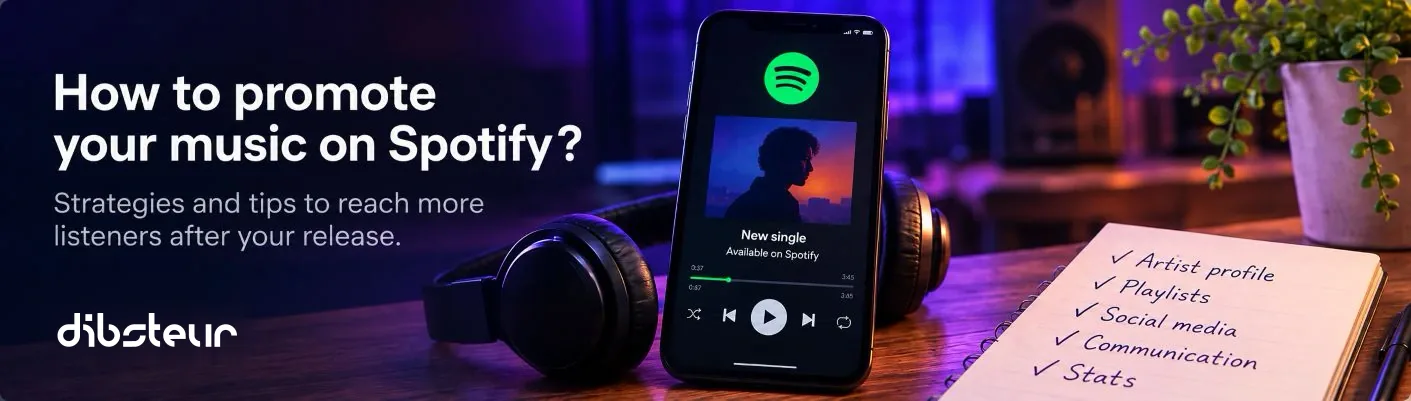
Prepare Your Spotify Music Promotion Before Release
Effective Spotify promotion ideally begins before release day. This gives you time to prepare the various communication materials, check your artist profile, and, most importantly, pitch an unreleased track to Spotify playlist editors when it is eligible.
Spotify allows artists and their teams to submit an unreleased song to playlist editors through Spotify for Artists. The platform states that a track must be submitted before its release and that submitting it at least seven days before the release date also allows the selected track to be included in the artist’s followers’ Release Radar. However, submitting a song does not guarantee placement in an editorial playlist: it simply allows you to present the track and its characteristics to Spotify’s teams.
It is therefore better to schedule the distribution date far enough in advance rather than putting a song online in a rush. This period can be used to prepare visuals, clips for social media, the text used to introduce the track, and the links that will allow listeners to easily access the release once it is available.
Preparation is particularly important when a single is accompanied by a music video, a social media campaign, a collaboration with another artist, or outreach to media outlets. All of these elements have a greater impact when they are coordinated around the same date rather than released without a clear schedule.
Optimize Your Spotify for Artists Profile
When a listener discovers a song and clicks on the artist’s name, the Spotify profile becomes a real presentation page. A consistent photo, an up-to-date bio, and a discography correctly linked to the right profile make the project easier to understand and provide more context for someone discovering the artist for the first time.
Spotify for Artists allows you to manage different elements of this presence and includes Artist Pick, which lets you highlight content directly on your profile. Spotify states that Artist Pick can be used to feature a new release, a playlist, a concert, merchandise, or other content associated with the artist.
The goal is not to fill every available space simply because it exists, but to create continuity in the discovery experience. If someone arrives on your profile after hearing your new single, the rest of the page should allow them to quickly understand who you are, what other music you have released, and what content you want to highlight at that time.
You should also make sure that every new release appears on the correct profile. An error in the artist name or in the metadata submitted during distribution can disrupt this continuity. This is another reason to carefully prepare a release before sending it to platforms.
Use Spotify Playlists to Promote Your Music
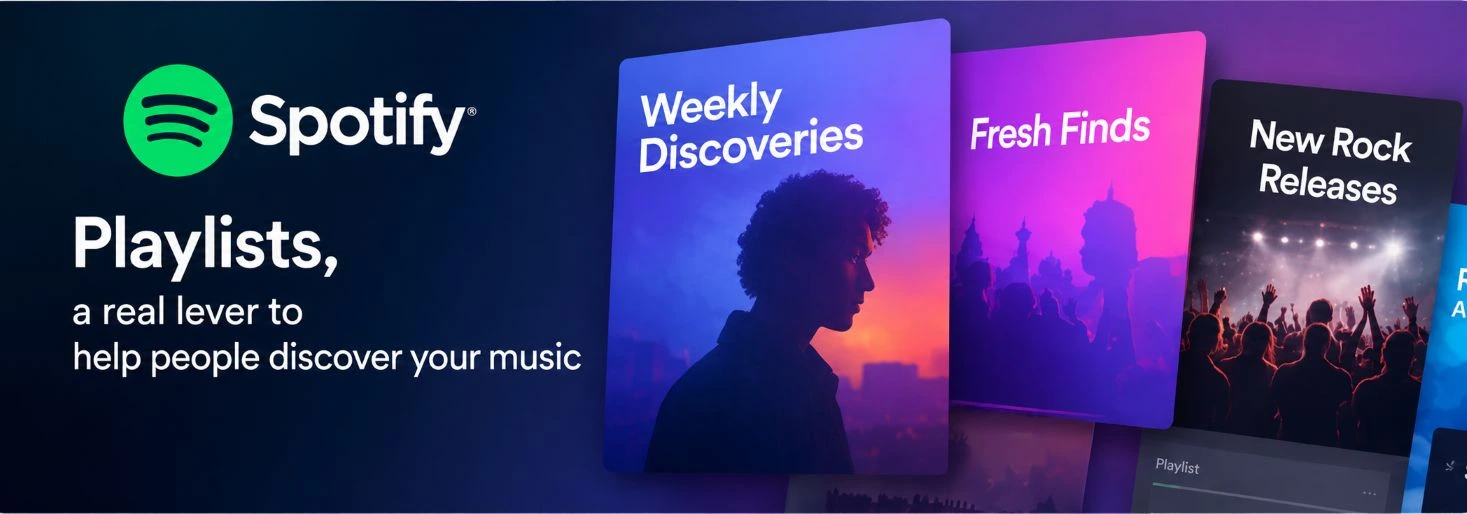
Playlists play an important role in music discovery on Spotify, but the term covers several different types. Some playlists are curated directly by Spotify’s teams, others are personalized or algorithmically generated, while many playlists are created independently by users.
For Spotify editorial playlists, the official way to submit an unreleased track is through the playlist pitching tool available in Spotify for Artists. Spotify states that artists have access to this submission process and that the final decision on whether or not to include a song belongs to the editorial teams.
This distinction is important when trying to promote music on Spotify. A playlist with a large following can generate new listens, but the raw number of streams should not become the only measure of success. You should also look at whether new listeners save the song, visit the profile, listen to other tracks, or continue following the artist over time.
Above all, you should be cautious with services that promise a guaranteed number of streams or guaranteed playlist placement in exchange for payment. Spotify explicitly states that third-party services that guarantee streams in exchange for payment are not legitimate and may violate its terms. The platform explains that artificial streaming can result in various measures, which may include the removal of content in some cases.
Music promotion should therefore aim to generate genuine listens rather than artificially inflate numbers.
Activate Your Social Media and Audience to Generate the First Streams
Spotify should not be treated as an isolated space separate from the rest of an artist’s communication. A song’s first listeners may come from Instagram, TikTok, YouTube, a newsletter, a concert, an existing community, or simply people who regularly follow the project.
When a track is released, it is generally more effective to give people a real reason to listen than to post the same link every day with the same message. A clip from the song, a video recorded during the recording process, an explanation of the track’s origin, or a few images from the music video can create several pieces of content around the same release without giving the impression that the same announcement is being repeated constantly.
Collaborations can also play an important role. When several artists participate in a track and each communicates with their own audience, the release can reach people who were not previously familiar with all of the participants. Once again, the quality of how the project is presented matters more than mechanically increasing the number of posts.
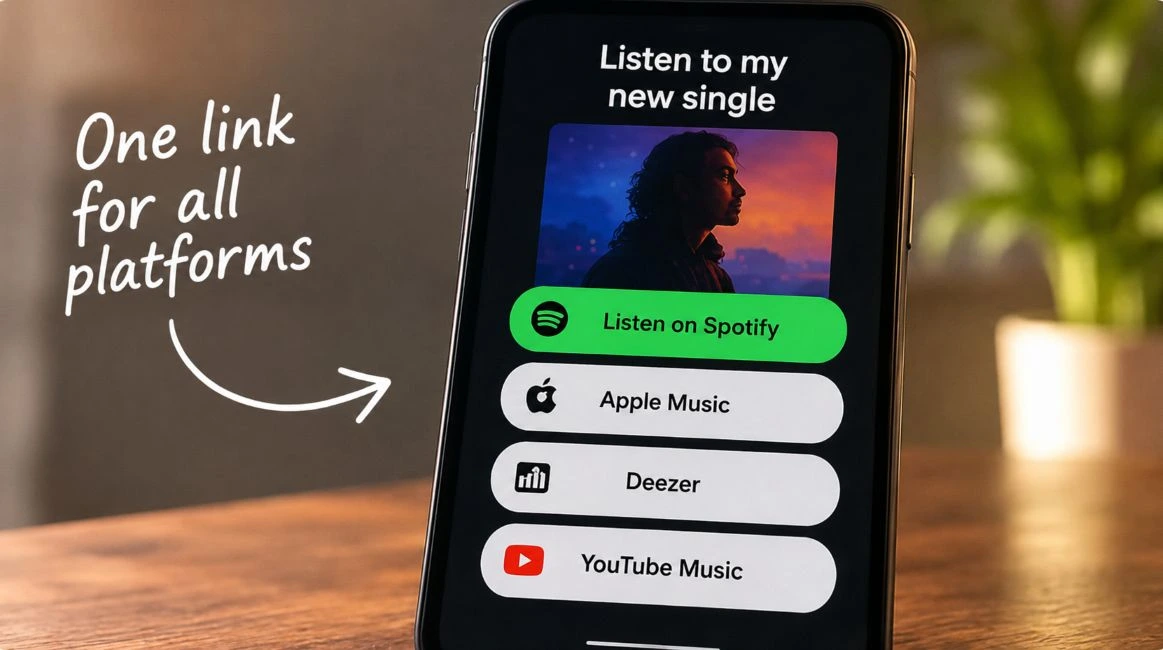
A single link that brings together the different platforms also makes the listener’s journey easier. Not everyone uses Spotify: some people may prefer Apple Music, Deezer, YouTube Music, or another platform. Promotion of the project can therefore begin with the song itself and then allow each person to choose their preferred streaming service.
Keep Promoting Your Song in the Weeks After Release
Many music promotion campaigns focus all their energy on release day and then almost completely stop a few days later. However, a song release can serve as the starting point for several weeks of content and analysis.
The first few days can focus on announcing the track and telling its story. The following week can highlight a clip, a music video, a performance, or behind-the-scenes content from its creation. Later, you can return to a particular audience reaction, a playlist in which the song appears, a collaboration, or simply another part of the track that has not yet been used in your communication.
This approach also helps avoid judging a song’s success solely on its first twenty-four hours. Building an audience is rarely perfectly linear. Some tracks quickly find their first listeners, while others grow more slowly as new content or recommendations bring them back into the spotlight.
Track Your Streams and Spotify Stats With Spotify for Artists
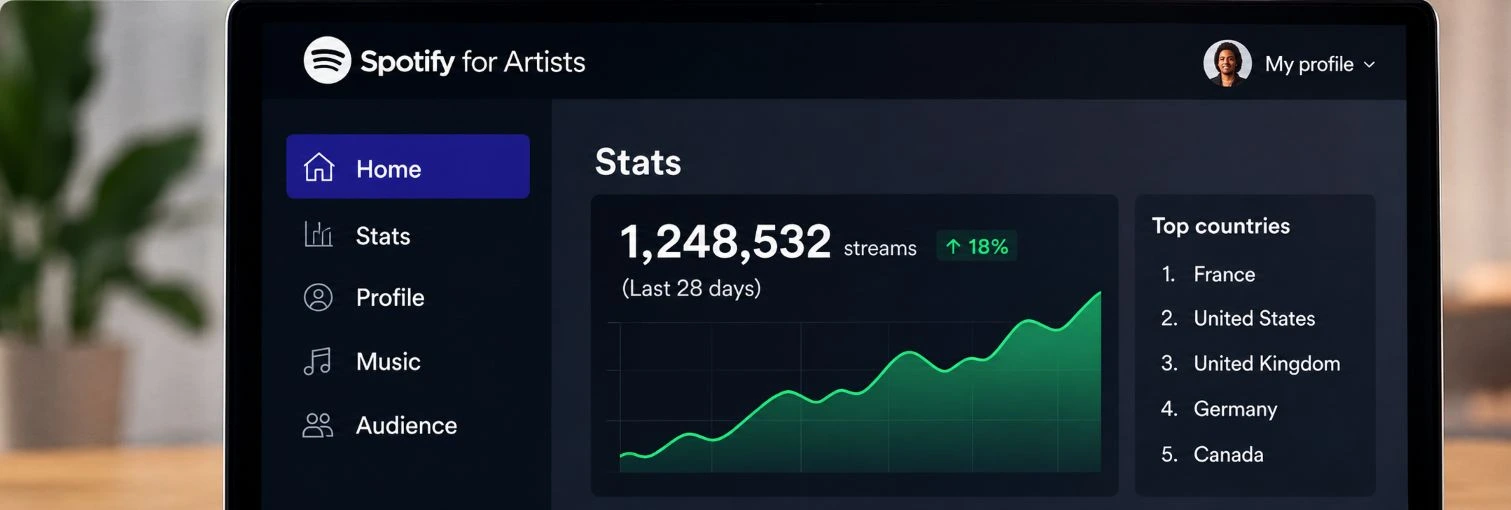
A Spotify promotion campaign becomes much more useful when it is accompanied by regular analysis of the results. Spotify for Artists allows you to track music and playlist performance as well as different information about your audience.
You should not look only at the total number of streams. Two songs generating a similar number of listens can follow very different paths. One may be listened to once by many people who never return, while another may reach fewer people but gradually build a core audience of listeners who save the tracks and follow the artist.
The available data can therefore help answer very practical questions. Did a social media post cause an increase in streams? Did a playlist bring in new listeners? Are certain countries or cities beginning to represent a significant share of the audience? Does a particular track encourage more people to explore the rest of the catalog?
Spotify itself presents its analytics tools as a way to track song and playlist performance while gaining a better understanding of your audience.
Dibsteur complements this analysis with statistics and reports associated with distributed tracks. The goal is then to look at the release as a whole, not only through Spotify, since the same song may also be available on Deezer, Apple Music, Amazon Music, YouTube Music, and the other platforms selected during distribution.
Grow Your Audience and Get More Streams on Spotify
The number of streams naturally remains an important indicator, but it does not tell the whole story of a music project. A strategy built solely around a counter can lead to poor decisions, particularly when it encourages the pursuit of artificial volumes or audiences that have no genuine affinity with the music.
Someone who discovers a song, saves it, comes back a few days later, and then listens to a second track can potentially be far more valuable to an artist’s development than a series of isolated streams from people who will never return.
This is why promoting a release should aim to build a relationship gradually. The music obviously remains at the center, but the artist profile, the content published around the release, the consistency of future releases, and the way the artist interacts with their audience all contribute to this development.
Spotify itself analyzes different levels of audience engagement in Spotify for Artists to help artists better understand the relationship between their listeners and their music.
Should You Pay to Promote Your Music on Spotify?
There is an important difference between buying advertising or using a legitimate promotional tool and directly buying streams.
An advertising campaign can introduce a song to new people, who remain free to listen to it or not. By contrast, a service that promises several thousand guaranteed streams for a fixed amount should immediately be treated with caution. As mentioned above, Spotify prohibits third-party services that guarantee artificial streams or sell this type of result.
For an independent artist with a limited budget, it is often better to gradually test several actions and observe which ones genuinely attract new listeners. A few well-prepared pieces of content, a targeted campaign, or a relevant collaboration can provide more useful information than a large budget spent without being able to understand where the generated streams came from.
The question is therefore not simply how much to invest in promoting a song, but whether you can measure what that investment actually contributes to the development of the project.
Distribute Your Music to Spotify With Dibsteur
Before you can promote a track on Spotify, it must first be properly distributed to the platform. With Dibsteur, you prepare your release from a single space by adding your audio file, cover artwork, metadata, credits, and release date, then select Spotify and the other platforms where you want to make your music available.
Once the release is published, you can track the statistics and reports associated with your distributed tracks through Dibsteur, while Spotify for Artists complements this information with data specific to your Spotify audience.
If your song is not online yet, our guide covers preparing the audio file, entering the metadata, choosing a release date, and delivering the song to Spotify through a distributor.
Read the guide on how to get your music on Spotify
Compare Dibsteur music distribution plans
Build a Long-Term Spotify Promotion Strategy
The best strategy is not necessarily the one that generates the biggest spike in streams on release day. A successful campaign should above all allow a song to gradually find its audience and give new listeners several opportunities to return to the artist.
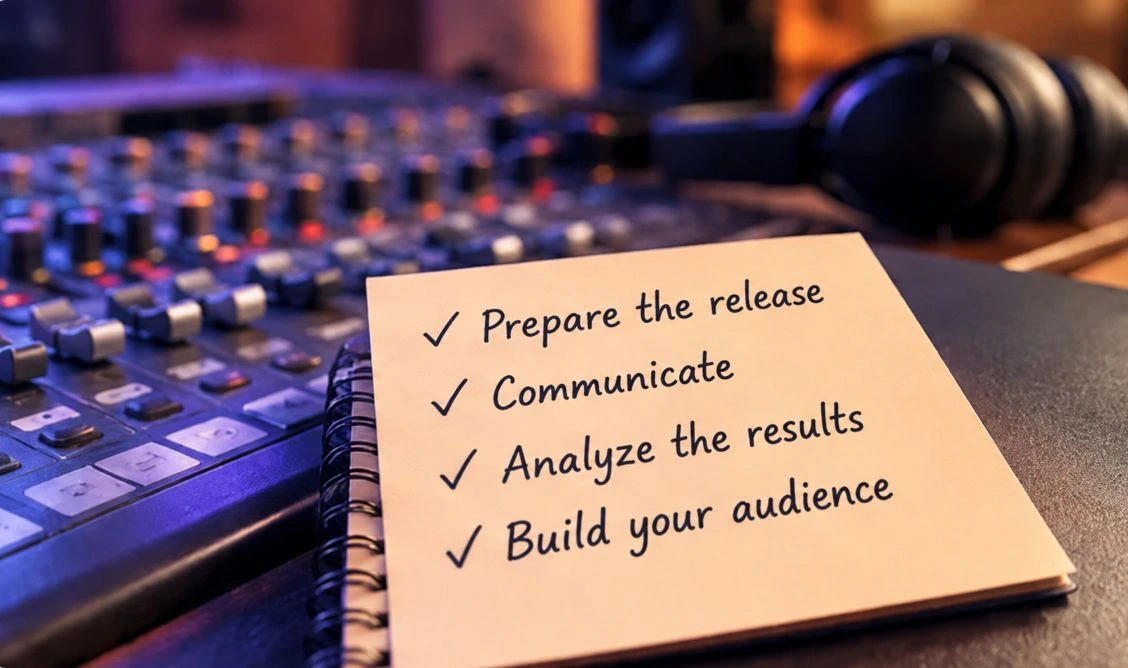
Preparing the release early enough, using the official Spotify for Artists tools, pitching the track to editorial playlists while it is still unreleased, communicating with your existing audience, and then analyzing the results allows you to work more methodically. You can then understand what actually generates new listens and use those lessons for the next release.
Promoting a song therefore does not end when it appears on Spotify. It continues throughout the track’s life after release and gradually becomes part of a broader strategy for developing the catalog and the audience.