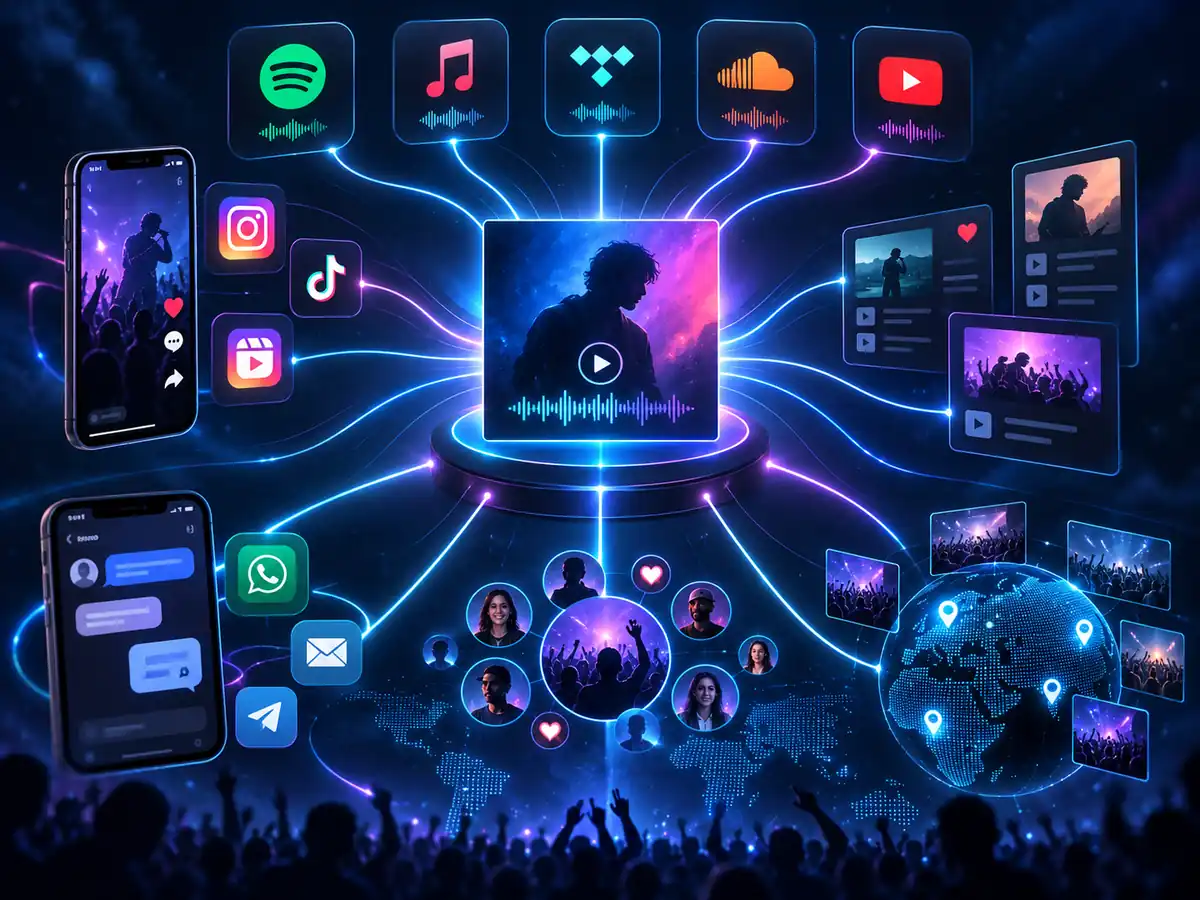
Music promotion before a song release
Waiting until the track is available before starting to communicate means losing some of the time that can be used to establish the project. As soon as the release date is reliable enough, the artist can prepare visuals, shoot several videos, organize the first announcements, select the media outlets to contact, and decide which content will be published before and after the release.
This phase of music promotion before the release does not need to follow a universal schedule. A single accompanied by a music video, an advertising campaign, and press outreach will require more preparation than a track intended primarily for an existing community. A few weeks may be enough for some projects; others will benefit from preparing their launch much earlier.
The main point is not to concentrate all communication on a single day. A preview, footage shot while creating the track, an announcement of the cover artwork, or a short video about the project can create several points of contact before the listener can hear the full track.
Music marketing for an independent artist
A campaign is not necessarily successful because it generates a lot of views; music marketing is instead about bringing a project closer to the people who are genuinely likely to be interested in it.
Depending on the stage of the artist’s career, the desired result may be very different: getting a first track heard, increasing the number of regular listeners, building a community, preparing for a concert, supporting an album, or simply bringing the audience back for a new release. An artist who is just starting out will therefore not use the same methods as a project that already has several thousand monthly listeners.
This difference should also be reflected in the metrics being tracked. A video viewed 100,000 times but generating very few streams or visits to the artist profile may have less value than more niche content that genuinely attracts new listeners. Building a music marketing strategy therefore also means deciding what you want to achieve before choosing the methods to use.
Promoting your music on social media
Social media makes it possible to present the same track in many different ways; repeating the cover artwork and listening link in every post is rarely enough to maintain interest.
Part of the chorus can be used in a short video, while another piece of content shows a recording session, the production of the track, a performance, or the story that inspired the lyrics. Behind-the-scenes content may interest some people, while others will respond more strongly to a direct performance or a very short, immediately recognizable excerpt.
To promote your music on social media, there is also no need to copy exactly the same content across every platform. TikTok, Instagram, YouTube, and other social networks do not have the same uses or formats. The choice depends on the artist’s audience and their actual ability to regularly produce suitable content.
Sometimes it is better to develop two accounts with genuine interaction than to maintain a minimal presence across six platforms. Social media promotion works even better when the content feels like real posts rather than simply repeated advertisements for the latest track.
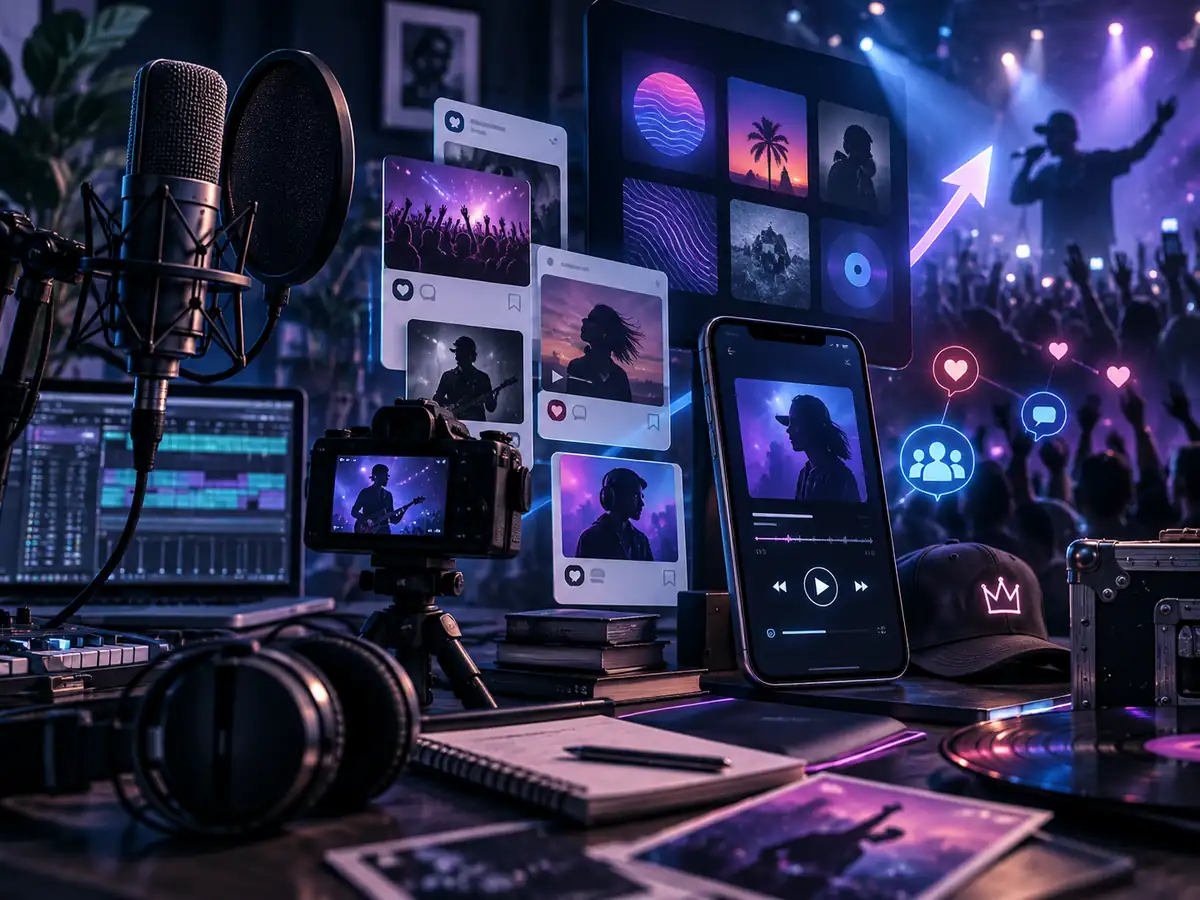
Artist promotion: getting a project noticed beyond a single song
When a listener likes a song, they may immediately look for previous tracks, open the artist’s profile, check their social media, or watch their music videos. Artist promotion should therefore encourage people to continue this discovery beyond the song that served as the entry point.
A certain level of consistency between photos, visuals, profiles, and the way the project is presented makes this recognition easier. This does not mean freezing the visual identity or reproducing the same cover artwork for every release; the goal is rather for someone who encounters several pieces of content to quickly understand that they belong to the same world.
Over time, this continuity also reduces the effort required for each new launch. Part of the audience already recognizes the name, knows a few tracks, and may be waiting for the next release. Promotion of the artistic project therefore builds progressively instead of starting completely from scratch with every single.
Artist press kit and music press kit
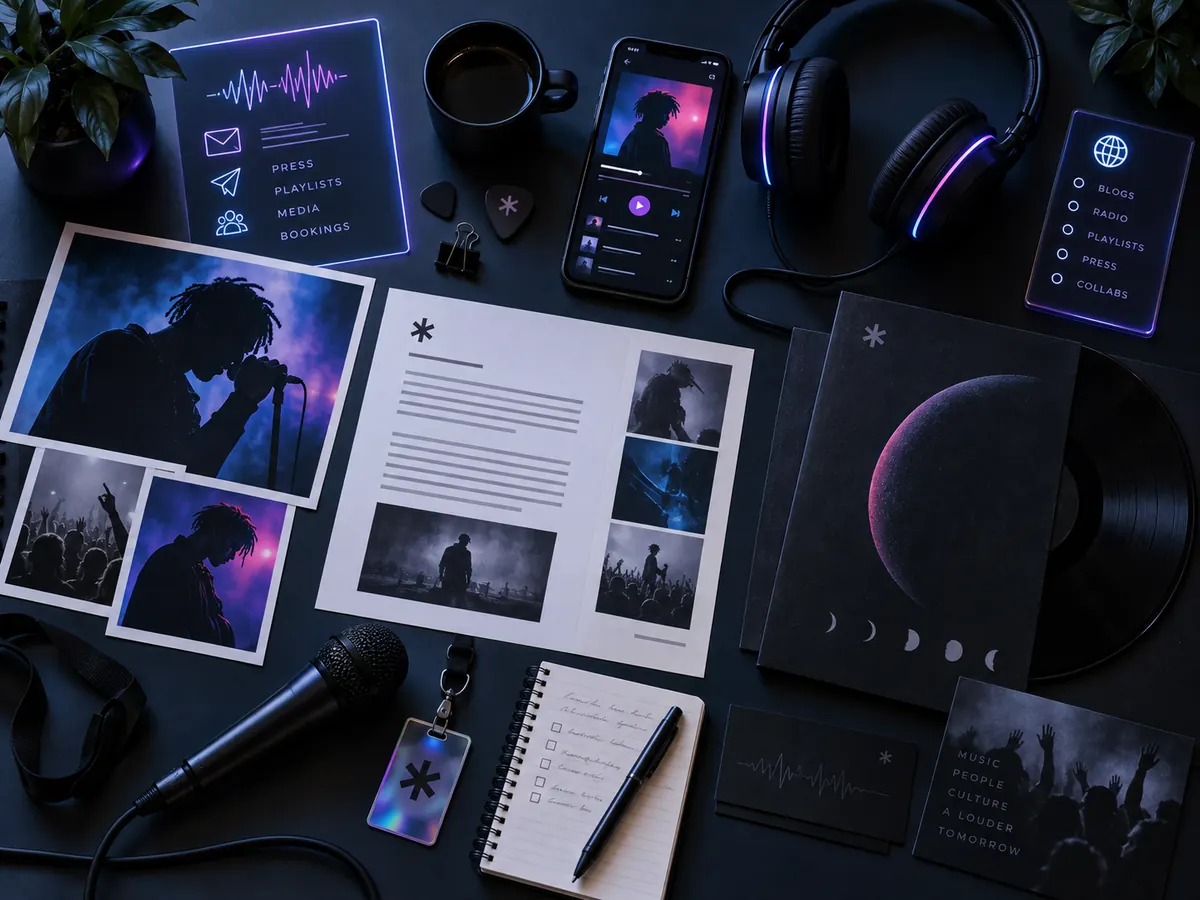
A media outlet, radio station, booking professional, or industry professional receiving a pitch should be able to quickly understand who the artist is and why this news might interest them. The artist press kit is used to bring the essential elements together in one place.
A short introduction to the project, a few usable photos, the main listening links, social media accounts, current news, and contact details are generally enough to create a clean foundation. If the artist already has major performances, collaborations, press articles, or other useful references, these can be added without turning the kit into an endless biography.
The music press kit, however, does not replace the message that accompanies it; a pitch personalized for the relevant media outlet makes more sense than an identical email sent to hundreds of addresses. An electronic music blog, a rap radio station, and a rock publication do not have the same audience or the same expectations.
The press kit mainly makes it easier to discover the project: the person being contacted should be able to listen to the music, quickly see the essential information, and find the resources they need without requiring multiple exchanges.
Music SmartLink: bringing all platforms together in a single link
Once the track is available, sharing only a Spotify link assumes that everyone uses Spotify. A listener on Apple Music, Deezer, or another service would then have to search for the track themselves.
A music SmartLink solves this problem by bringing several destinations together on the same page. A single URL can be placed in a bio, sent to the press, used in a newsletter, or added below a video. The listener then directly chooses the platform they prefer.
This type of link becomes particularly useful when a campaign uses several channels. Instead of managing different URLs for each network or service, the artist keeps a single destination throughout the promotion.
Dibsteur currently includes customizable SmartLinks in its distribution plans, making it possible to directly connect the release of the track with its promotion.
Spotify pre-save before the release
Before publication, the listener cannot yet hear the full track. A Spotify pre-save, however, allows them to save the release in advance so they can find it when it becomes available.
This mechanism is especially useful when an artist already has an audience engaged enough to take action before the release date. An announcement or excerpt can then lead to an immediate action rather than simply saying “come back in two weeks.”
A pre-save is still a tool, not a strategy; if no one knows the artist yet or has a reason to be interested in the track, the presence of an additional button will not automatically create demand. The quality of the content and the ability to generate interest remain the priority.
A Spotify pre-save campaign therefore works best as part of an already organized launch, alongside announcements, videos, and other actions planned before publication. Learn how to create a Spotify presave link before a song is released.
Spotify promotion and playlists
Playlists can provide access to new listeners, but Spotify promotion is not limited to seeking playlist placement.
Editorial playlists, algorithmic recommendations, and user-created playlists follow different systems. The artist profile, release history, genuine listener engagement, and preparation of the track also contribute to how the music circulates on the platform.
We have therefore created dedicated content on how to promote your music on Spotify, in order to cover the tools and playlists without turning this general article on music promotion into a guide focused solely on Spotify. To prepare the release of a single or EP, it is also important to choose the right format before the campaign.
However, services that artificially guarantee a specific number of streams should be avoided. Presenting a track to a potential audience is promotion; generating streams that do not come from real listeners builds neither a community nor lasting interest in future releases.
Music collaboration and promotion between artists
Two projects working together bring together more than their voices or productions. They can also combine their audiences, some of their content, and sometimes their professional networks.
A consistent music collaboration naturally creates several distribution points for the track. Each artist can present the track from their own account and tell the story of the project from a different angle. People who follow one artist may then discover the work of the other.
This approach does not always require a feature. A joint performance, a remix, a live performance, video content, or a cross-recommendation can also be used for promotion between artists.
Community size should not be the only criterion for choosing a collaboration. A project with a smaller audience but a very similar musical style may generate more relevant discoveries than a much larger account whose audience does not match the style of the track at all.
Advertising to promote your music
Buying visibility is relatively simple; buying the attention of people who are genuinely interested in the music is much more difficult.
A music advertising campaign should therefore begin with a destination and an objective: showing an excerpt to new listeners, sending people to a SmartLink, increasing views of a music video, or introducing an artist profile. Without this step, the budget may generate a large number of impressions without producing any useful result.
It is often better to test several creative assets with limited amounts before increasing spending on the ones that work. Two excerpts from the same track can produce very different reactions, just like a music video, a performance, or simpler content filmed in the studio.
To promote your music with advertising, cost per view is not always the most relevant metric. A slightly more expensive campaign that brings people to the track or artist profile may have more value than a campaign producing many cheap views without any action afterward.
Promoting your music on a small budget
With limited resources, the priority is to choose actions that can genuinely be carried out properly.
An artist with 100 or 200 euros will probably not be able to fund a publicist, several music videos, and a large advertising campaign at the same time. They can, however, produce a series of pieces of content themselves, prepare a strong visual, contact a few relevant media outlets, and reserve part of the budget for an advertising test.
With music promotion on a small budget, time often replaces part of the money. Researching contacts, preparing several videos during the same session, responding to the audience, or analyzing performance requires work, but not necessarily additional spending.
The first results can then help determine where to invest more money. If certain types of content genuinely attract new listeners, it makes more sense to strengthen that format than to mechanically divide the budget among every available technique.
Continuing to promote your music after the release
Release day is an important moment in a release promotion strategy, but it is not an expiration date.
A track can begin circulating several weeks after its release. A music video published later can restart discovery, a live version can reach another audience, a playlist can generate a new wave of streams, and a video that suddenly performs well on a social network can bring attention back to a track that is already available.
Continuing to promote your music after the release is particularly useful when an artist releases music infrequently. A single track can provide content for several weeks without requiring exactly the same post to be repeated.
The duration of the campaign mainly depends on what is genuinely left to say or show around the track. When a new action no longer adds anything, it becomes more worthwhile to prepare the next release rather than artificially extending the communication.
Music statistics: measuring promotion results
A high number of views does not necessarily mean that a campaign has helped grow an artist’s audience. To understand what works, music statistics must be considered in relation to the objective chosen at the start.
A campaign designed to introduce a track can be evaluated through new listeners and streams. An initiative intended to build a community should focus more on followers, engagement, or profile visits. Geographic distribution can also reveal that a release is beginning to find an audience in an unexpected territory.
Comparing several actions then becomes informative, because a video with few views may send many people to the track, while viral content may have almost no effect on streams. This information prevents apparent visibility from being used as the only measure of success.
Tracking performance mainly helps improve future promotion campaigns. The artist can identify the formats that genuinely attract listeners, unnecessary spending, and the platforms where the project performs best.
Dibsteur makes it possible to track detailed daily statistics for distributed projects.
Spotify Discovery Mode and music promotion
For certain eligible tracks and artists, Spotify offers an additional feature around its recommendations: Discovery Mode.
It works differently from a traditional advertising campaign. The artist does not pay directly to purchase a defined number of streams, and Spotify retains control over the recommendation. The feature operates within certain discovery contexts on the platform, with a specific model applied to the relevant royalties.
As part of a music promotion strategy, Spotify Discovery Mode can therefore complement other actions when a catalog contains eligible tracks. Dibsteur provides access to this feature under the conditions applicable to the relevant tracks.
Its operation, eligibility, and campaign analysis are detailed in our guide dedicated to Spotify Discovery Mode.
Music promotion and distribution: making the release available at the right time
A campaign prepared over several weeks immediately loses effectiveness if the track is not available on the announced date or appears with incorrect information.
Music distribution must therefore be integrated into the promotion schedule. The final file, cover artwork, credits, metadata, artist profiles, and selected platforms must be ready early enough so that promotional content can then direct the audience to a properly published release.
This coordination becomes even more important when a campaign includes a press kit, advertisements, several pieces of content, or a SmartLink: each element ultimately directs people to the distributed music.
With Dibsteur, artists can prepare their releases, distribute them to partner platforms, and then use tools related to promotion and performance tracking. Dibsteur’s music distribution offers include SmartLinks and statistics in particular, as well as certain services such as Spotify Discovery Mode depending on eligibility requirements. A clear artistic direction also helps make a release recognizable.